Low-Maintenance Inertia in Friendships: A Quiet Drift of Friendship in Adulthood.

Standard

Do you find yourself sending a message and watching it sit unanswered for weeks? Struggling to remember the last time you met a friend one-to-one? Noticing that when you do meet up, it’s usually as couples rather than simply as friends?

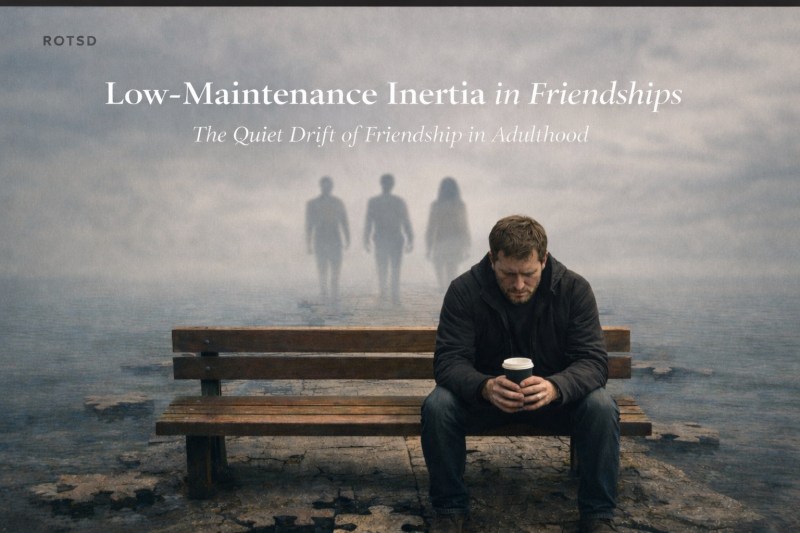
I have found this to be increasingly common in adult life — friendships simply ticking over day to day, minimal effort, slow momentum, until suddenly they drift into a quiet, low-maintenance state. There is no falling out, no hostility, just a gradual slowing of responsiveness, friendships quietly deprioritised rather than consciously discarded, that I can only describe as a low-maintenance drift of the friendship.

The strange part about this drift is how invisible it is while it happens. Friendships rarely collapse in dramatic ways; more often, they simply lose momentum, month by month, until the distance only becomes visible when something important happens and you suddenly want to reach for the connection that once felt effortless, but now feels like an inertia.

So why does this happen? My theory — based purely on observation — is that it sits within our increasingly busy culture. We are always striving for more: a good job, financial stability, a home, the ability to support a family. Romantic relationships often become the default social unit, while parenthood and careers consume most of our available bandwidth. At the same time, digital communication creates the illusion of connection without requiring the effort that real connection demands.

I have been ruminating on this idea of low-maintenance inertia for months now — perhaps even a couple of years. One thing that stands out to me is that men seem more likely to fall into this pattern than women. I often notice “girls’ nights” or women intentionally maintaining their friendships, whereas many men tend to socialise through their partner’s networks rather than their own.

This raises an interesting question: do men prioritise their immediate sphere over their wider sphere? In other words, does the focus on home, partner, and children gradually replace the maintenance of friendships? If so, could this partly explain why so many men experience loneliness or struggle to speak openly when they face emotional difficulty? Perhaps when the moment comes to have those deeper conversations, they realise the friendships that once held that space have quietly drifted into inertia.

The difficulty often begins when you finally notice the inertia. That awareness usually arrives at the same time as a sudden craving for the friendships that once existed — the deep conversations, the shared perspective, the sense of cognitive companionship that used to come naturally.

Instead, you begin to encounter slow responses or silence. Frustration creeps in. Patience and energy begin to erode in subtle ways. You seek perspective but find quiet. The mind starts to ruminate and reflect, and a quiet loneliness can follow.

The strange part is that nothing has really changed. Your friends are behaving much the same as they have for years — and, if you’re honest, perhaps you have been too. The difference is that now you are the one who has begun to notice the inertia. You are the one beginning to crave the change. They may not even realise it yet.

For a long time, I was quite content letting my friendships tick along quietly — chatting when we had time, meeting up occasionally when schedules allowed. But a recent life shift has made me notice the distance more clearly. Conversations that once happened daily or weekly have slowly become monthly, or even less frequent.

My partner and I are expecting our first child, and I found myself in an unexpected position: worrying that telling some of my closest friends might result in the message sitting unread for weeks. Not because they do not care, but because this is the rhythm our friendships have quietly fallen into.

I watched my partner discover the news in a very different way. Within minutes, she FaceTimed her friends. They picked up immediately, celebrated with her, and shared the moment together.

Meanwhile, fourteen weeks passed, and I found myself carefully drafting messages — trying to create the right opening that might lead to a conversation, before eventually realising that the simplest option was to send one message and share the news directly. Anything else might take months to unfold through the usual slow exchanges.

To be clear, this isn’t true of all my friendships. One friend visited and found out very early on. But the experience highlighted something unexpected: when friendships have lived in this low-maintenance state for long enough, even sharing the biggest moments in life can begin to feel strangely awkward.

It’s important to note that this isn’t about the end of friendships. Rather, it is about recognising when these relationships have quietly been taken for granted and infrequently nurtured. Life gets in the way of most things. It is rich, chaotic — and that is part of what makes it wonderful.

In many ways, the longing to reconnect with these friendships only highlights how fortunate I am to have these people in my life. I am deeply grateful for them. They have shaped me just as much as I have shaped them. But recognising the inertia is important, because sometimes friendships simply need a little attention before the distance grows too great.

So how do we break the inertia? For me, this is still a work in progress. I certainly don’t have all the answers, and every friendship will likely require a different approach. The first step, however, is simply naming it and recognising that it exists. From there, it might mean being more intentional about organising time together, rather than waiting for convenience.

For me, reflection has also helped. Thinking through the idea, writing it down, and shaping it into this blog post has allowed me to understand my own thoughts more clearly.

Finally, there is also an acceptance that some friendships are seasonal rather than broken. People move through different stages of life, and relationships naturally shift with them.

The aim of this post was simply to put words to something I had been quietly ruminating about for some time. If you have felt this drift too, then perhaps it helps to know you are not alone. 

When was the last time you reached out to a friend simply to maintain the friendship rather than because circumstances brought you together?

Sometimes friendships do not fracture — they simply fade into inertia. The real danger of low-maintenance inertia may not be that friendships end, but that we only notice their value at the exact moment we realise how quiet they have become. Perhaps naming that inertia is the first step toward restoring the friendships that once provided that quiet form of cognitive companionship.
Weltschmerz: The Pensive Melancholy of Modern Life

Standard

The Quiet Weight

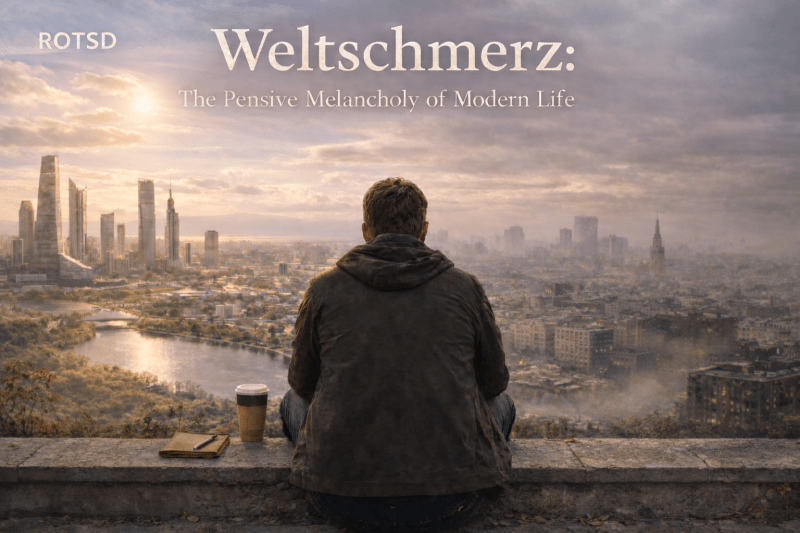
Ever feel like life isn’t progressing in the same direction as you? Not your own life, necessarily, but the world around you. As though something has stalled, or drifted slightly off course.

The way we believe the world should be doesn’t quite align with how it is. You can’t always place it, but it sits there, quietly, uncomfortable and persistent. A dulled frustration. A low-level disappointment, humming in the background.

Modern life only amplifies it. A constant bombardment of noise, much of it heavy, seldom uplifting. Everything feels urgent, yet nothing feels like true progress.

And somewhere within that, a subtle shift begins, from living with purpose to simply going through the motions.

A Subtle Realisation

For me, this feeling has lingered throughout much of my adult life. Growing up, it was almost implied; if you studied well, worked hard, and engaged in the world as you were told, things would fall into place. Life would, in some way, make sense.

As I got older, that idea softened. I came to understand that effort does not always equate to success, and that much of life is spent navigating setbacks, learning, and gradually finding your footing. I had assumed that the quiet frustration I felt stemmed from this; the gap between a simplified promise and a more complex reality.

But more recently, I’ve begun to question that. The feeling seems less about personal trajectory and more about the structure of the world itself. There is a sense that the system we exist within is uneven, that opportunity, ease, and progression are not distributed as fairly as we might hope. Some seem to move freely, while others remain constrained, despite equal or greater effort.

This isn’t a claim of personal hardship. I’m aware that I have benefited from circumstances that have positioned me ahead of many others. Privilege is not defined by what we lack, but by what we have been given, often without realising it, or quietly taking it for granted. And yet, even with that awareness, the discomfort remains.

Naming It: Weltschmerz

It was around this point that I came across the German word Weltschmerz. Perhaps this is why it resonates, because it captures something more than disappointment.

It is the quiet unease that emerges when we are unable to reconcile the world as it is with how we feel it should be.

The difficulty is that, once you become aware of it, it is not easily set aside. The more you begin to see, the harder it becomes to ignore.

The Modern Amplifier

I find myself feeling this more strongly now than I ever have before. Perhaps it is a reflection of the current climate, a growing sense of helplessness, paired with a constant exposure to the world’s problems.

Modern life amplifies awareness, but rarely offers resolution. We are surrounded by a continuous stream of information, opinion, and reaction; much of it immediate, much of it emotionally charged. Social media, in particular, creates a space where outrage is easily expressed, but rarely translated into meaningful action.

It begins to feel like a bombardment of awareness without progression. We are given tools that suggest participation; the ability to comment, share, react, and in doing so, it can feel as though we are contributing. But often, that expression is fleeting. It releases the emotion, without necessarily creating change.

And over time, this cycle reinforces the feeling: seeing more, feeling more, yet remaining largely powerless within it.

It creates a kind of stagnation; outrage without progression, emotion without direction. The response becomes immediate, but rarely sustained long enough to translate into meaningful change.

And perhaps more frustratingly, it begins to feel as though that outrage is absorbed into the background, reduced to noise, easily overlooked by those in positions to facilitate change.

The Conflict of Caring

This is where, for me, my Weltschmerz is most felt. I care deeply, and because of that, I feel it.

There is an unspoken suggestion that if you do not publicly express that feeling, then you do not care. But this isn’t the case. It is entirely possible to feel something deeply without needing to perform it outwardly.

And perhaps this is where the tension begins to form: between awareness, helplessness, and a perceived responsibility to respond. Over time, that tension can become exhausting, and what begins as care can slowly give way to disengagement, or even apathy.

Macro vs Micro Action

I think part of the issue lies in a misunderstanding between what I would describe as macroscopic and microscopic action.

Macroscopic action is visible; large-scale, immediate, and often associated with forcing change. It is what we tend to recognise as “doing something.”

But microscopic action is quieter. It exists within our immediate sphere: how we act, how we treat others, the small, consistent decisions we make. It rarely feels like enough in the moment, but over time, it is what shapes the larger picture.

Perhaps the difficulty is that we have become conditioned to expect the outcome without fully engaging in the process — to seek the destination, without committing to the journey required to reach it.

A Heavier Question

For me, there are moments where the world feels gravely broken. And in those moments, I feel it more heavily than usual.

As I prepare to become a parent, that feeling takes on a different weight. There is a quiet fear in it; a question that sits just beneath the surface: how do you bring life into a world that can feel so heavy?

A Different Approach

Historically, my response has been to chase the problem; to try and create as much meaningful change as possible, to carry the weight of it all and attempt, in some way, to shift the world forward on my own.

It feels like a natural reaction. But it is also unsustainable. Over time, that approach leads not to progress, but to burnout; to a quiet overwhelm that pulls you away from the very things closest to you. In trying to carry everything, you risk becoming less present within your immediate world, where your impact is most real.

Perhaps what these moments require is something different: pause, reflection, and a return to smaller, more intentional action. Not because it is easier, but because it is sustainable.

This kind of action will not change the world overnight. But it protects what is within reach. It steadies you. And over time, through consistency rather than intensity, those smaller actions begin to shape something larger.

Maybe the answer is not to carry the weight of the world all at once, but to hold a small part of it, properly, and trust that, in doing so, change can still take form.

And perhaps, in doing so, we make the world just a little lighter; not all at once, but where it matters most.

Carrying It Forward

For me, moving forward, I’ll be taking a more reflective approach.

That means being more selective with where I place my attention, recognising that not everything deserves my emotional energy. It means localising my impact, focusing on what I can influence rather than being overwhelmed by what I cannot.

It means processing more privately, rather than feeling the need to perform publicly. And continuing to regulate in ways that ground me, through writing, running, and music.

Often, that looks like returning to certain songs like Iron Sky, Never Been Better, or They Don’t Care About Us, music that doesn’t necessarily resolve the feeling, but allows me to sit with it, to process it, and to understand it a little more clearly.

Not ignoring the issues, but remaining quietly steady within them.

Weltschmerz doesn’t disappear; it becomes something you carry differently. The aim isn’t to fix the world, or to silence the feeling. It’s to stay aware, stay grounded, and not lose yourself in the weight of it.

Perhaps the goal is not to escape the weight of the world, but to learn how to carry it, without letting it quietly consume us.

Finding Rhythm: The Triad of Movement, Reflection and Study

Standard

When Life Loses Rhythm

Sometimes life has a way of catching up with you. Obstacles arrive from every direction, and you find yourself constantly reacting — responding to problems, obligations, and news. There is no pause to regather your thoughts, reconnect with hobbies, or reset your foundations. For me, it can begin to feel as though I am surviving rather than living.

More recently, I have noticed a pattern within myself: I tend to move directly onto the next challenge as soon as the previous one concludes. My greatest weakness is that the pause feels like inertia. Yet paradoxically, when I begin the next challenge, all I crave is a pause.

I often visualise this as hurdles in athletics. Once I clear one hurdle, I immediately sprint toward the next rather than allowing the next hurdle to come naturally to me. Occasionally, this mentality is useful. But over the last six years, I have rarely felt as though I have truly stopped.

And yet, during this period, I have achieved a great deal. I completed a full-time degree while working full-time. I began and established a relationship. I started a new job and moved to a new city where I initially had a very limited support network. Now I also find myself preparing to become a father.

Part of this drive has been fuelled by a fear that I had stagnated for nearly ten years beforehand — that my potential was fading and might never fully come into existence. But when I look back now, I also look at that time with a certain fondness. It was a time when I felt stronger.

I now wonder if what I am feeling is something different. Perhaps it is nostalgia. Perhaps it is simply a craving for the pause — the opportunity to reset foundations that have gone largely unacknowledged for six years.

Because during that earlier time, I felt something different. I felt more present. My life seemed to sit closer to equilibrium. I felt sustainably productive.

So why is this?

I was achieving less, yet somehow feeling like I was achieving more.

Is this simply a case of the grass appearing greener in hindsight? Or is it a deeper imbalance between personal growth and professional or social growth?

Upon reflection, I realised something important.

It was never really about motivation or discipline.

It was rhythm — that quiet structure that allows the body and mind to remain steady even when the outside world feels unsettled.

Without that rhythm, progress begins to feel less like growth and more like a caffeine-fuelled, anxiety-driven push to keep achieving.

And one thing feels certain: if I continue pushing in this direction, eventually a hurdle will trip me up before I ever reach the finish line.

Rediscovering Rhythm

So how do you establish a rhythm?
How do you anchor yourself within everyday life?
How do you truly relax and feel refreshed?

For a long time, I assumed rest simply meant doing less. Yet I could spend an entire day lying on the sofa, drifting in and out of naps, and still feel more tired than when I started.

Eventually, I began to notice something — something that used to exist in my life but had quietly faded.

Over time, and only through reflection, I realised that I had once fallen into a pattern without consciously designing it. It was not a single habit or routine, but rather three practices that naturally supported one another.

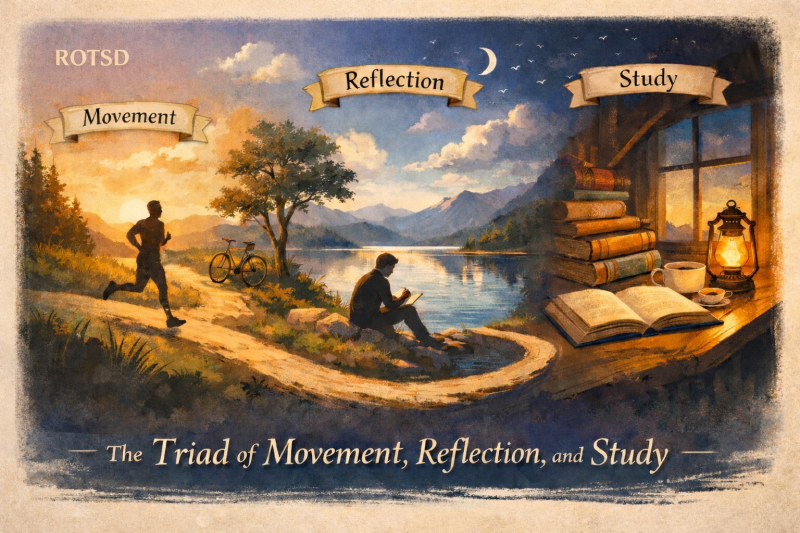
A triad — one that quietly allowed for both readjustment and growth.

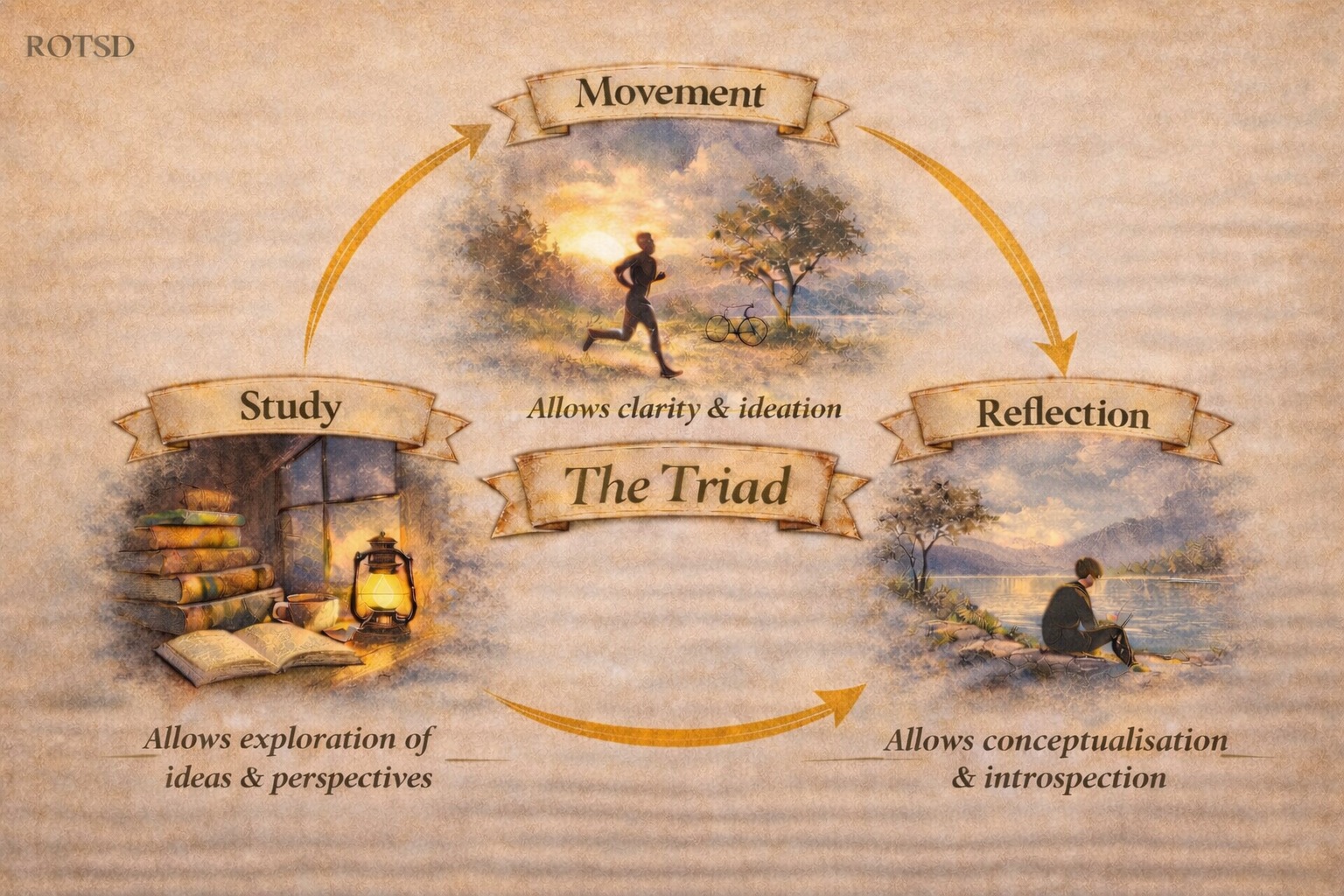
Three simple anchors that helped maintain rhythm between effort and recovery: movement, reflection, and study.  for me, none of these practices exist in isolation, but each one strengthened the others. Movement creates the space for ideas, reflection gives them structure, and study expands them beyond the self. Over time, they form a cycle — a rhythm that sustains both clarity and growth.

Movement

Movement is about grounding the body and creating clarity in thought. It allows space for ideas to emerge and for potential solutions to surface naturally.

For me, this takes the form of running, cycling, going to the gym, or even just walking. I have also found music to be an amplifier within this process.

Originally, as a teenager, whenever I felt overwhelmed by the chaos life was throwing at me, I would run until I had no energy left. It would temporarily calm and clear my mind. The first concern to resurface afterwards was often the one I focused on — almost as if my subconscious had prioritised it as the most important.

Over time, this evolved. Movement became less about exhaustion and more about restoration. Now, I can jog and feel my mind gradually clear, allowing ideas to form, problems to simplify, and even past successes to resurface.

These then form the foundation for reflection.

Reflection

Reflection is the time intentionally set aside to understand experiences more deeply. It allows me to process what has happened, examine ideas further, and work through potential solutions.

For me, this often takes the form of journaling or writing short reflections — whether personal or work-related — focusing on what I need to do to progress or overcome perceived barriers.

Writing things down creates a sense of distance from the thoughts themselves. What once feels tangled and overwhelming begins to take shape. It becomes easier to view ideas from different angles, question assumptions, and recognise patterns that would otherwise go unnoticed.

Over time, I have found reflection to be less about finding immediate answers and more about creating clarity. It turns experience into something that can be understood, rather than simply reacted to.

But reflection alone can sometimes become circular. Without new perspectives, thoughts can loop rather than evolve — creating the need for study.

Study

Study is the exploration of ideas and perspectives that may not have come to me naturally. It introduces new ways of thinking, allowing me to step outside of my own assumptions.

For me, this often takes the form of reading or listening to podcasts. Through this, I am exposed to perspectives and angles I may not have previously considered.

Study allows my reflections to connect with something broader. Ideas that once felt isolated begin to align with wider philosophies and bodies of knowledge. It adds depth to reflection and prevents thinking from becoming closed or repetitive.

It transforms reflection from something internal into something connected.

Adaptability of the Triad

It’s worth acknowledging that this triad is not a fixed formula.

While these three elements — movement, reflection, and study — form the structure, how they are expressed will differ for each person.

For some, movement may not be running or the gym, but gardening, DIY, or other hands-on activities that allow the body to engage while the mind begins to clear.

Reflection may not come through writing, but through conversation, meditation, or simply taking time to think without distraction.

Study, too, does not need to be confined to books or podcasts. It can come through curiosity — asking questions, listening to others, and engaging with perspectives that challenge your own, particularly those rooted in different experiences or beliefs.

The form may change, but the function remains the same.

It is about creating space for the body, the mind, and understanding to develop together.

I’ll conclude with this: When you find yourself continuously chasing, reacting, and adapting to challenges, pause. Establish your triad. Regain clarity and internal stability to provide the foundations needed to navigate an increasingly complex world.

Without that rhythm, life becomes a series of hurdles taken at speed. With it, the space between them begins to matter just as much as the jump itself — not just something to pass through, but something to live within.