
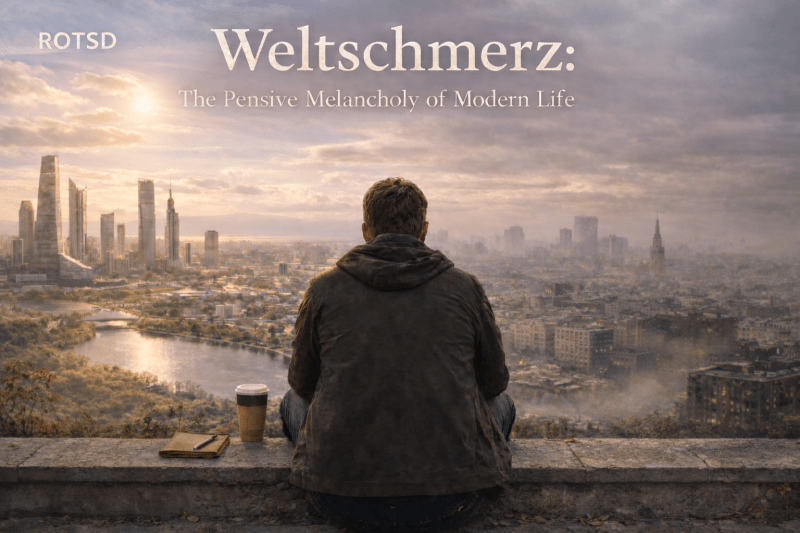
The Quiet Weight
Ever feel like life isn’t progressing in the same direction as you? Not your own life, necessarily, but the world around you. As though something has stalled, or drifted slightly off course.
The way we believe the world should be doesn’t quite align with how it is. You can’t always place it, but it sits there, quietly, uncomfortable and persistent. A dulled frustration. A low-level disappointment, humming in the background.
Modern life only amplifies it. A constant bombardment of noise, much of it heavy, seldom uplifting. Everything feels urgent, yet nothing feels like true progress.
And somewhere within that, a subtle shift begins, from living with purpose to simply going through the motions.
A Subtle Realisation
For me, this feeling has lingered throughout much of my adult life. Growing up, it was almost implied; if you studied well, worked hard, and engaged in the world as you were told, things would fall into place. Life would, in some way, make sense.
As I got older, that idea softened. I came to understand that effort does not always equate to success, and that much of life is spent navigating setbacks, learning, and gradually finding your footing. I had assumed that the quiet frustration I felt stemmed from this; the gap between a simplified promise and a more complex reality.
But more recently, I’ve begun to question that. The feeling seems less about personal trajectory and more about the structure of the world itself. There is a sense that the system we exist within is uneven, that opportunity, ease, and progression are not distributed as fairly as we might hope. Some seem to move freely, while others remain constrained, despite equal or greater effort.
This isn’t a claim of personal hardship. I’m aware that I have benefited from circumstances that have positioned me ahead of many others. Privilege is not defined by what we lack, but by what we have been given, often without realising it, or quietly taking it for granted. And yet, even with that awareness, the discomfort remains.
Naming It: Weltschmerz
It was around this point that I came across the German word Weltschmerz. Perhaps this is why it resonates, because it captures something more than disappointment.
It is the quiet unease that emerges when we are unable to reconcile the world as it is with how we feel it should be.
The difficulty is that, once you become aware of it, it is not easily set aside. The more you begin to see, the harder it becomes to ignore.
The Modern Amplifier
I find myself feeling this more strongly now than I ever have before. Perhaps it is a reflection of the current climate, a growing sense of helplessness, paired with a constant exposure to the world’s problems.
Modern life amplifies awareness, but rarely offers resolution. We are surrounded by a continuous stream of information, opinion, and reaction; much of it immediate, much of it emotionally charged. Social media, in particular, creates a space where outrage is easily expressed, but rarely translated into meaningful action.
It begins to feel like a bombardment of awareness without progression. We are given tools that suggest participation; the ability to comment, share, react, and in doing so, it can feel as though we are contributing. But often, that expression is fleeting. It releases the emotion, without necessarily creating change.
And over time, this cycle reinforces the feeling: seeing more, feeling more, yet remaining largely powerless within it.
It creates a kind of stagnation; outrage without progression, emotion without direction. The response becomes immediate, but rarely sustained long enough to translate into meaningful change.
And perhaps more frustratingly, it begins to feel as though that outrage is absorbed into the background, reduced to noise, easily overlooked by those in positions to facilitate change.
The Conflict of Caring
This is where, for me, my Weltschmerz is most felt. I care deeply, and because of that, I feel it.
There is an unspoken suggestion that if you do not publicly express that feeling, then you do not care. But this isn’t the case. It is entirely possible to feel something deeply without needing to perform it outwardly.
And perhaps this is where the tension begins to form: between awareness, helplessness, and a perceived responsibility to respond. Over time, that tension can become exhausting, and what begins as care can slowly give way to disengagement, or even apathy.
Macro vs Micro Action
I think part of the issue lies in a misunderstanding between what I would describe as macroscopic and microscopic action.
Macroscopic action is visible; large-scale, immediate, and often associated with forcing change. It is what we tend to recognise as “doing something.”
But microscopic action is quieter. It exists within our immediate sphere: how we act, how we treat others, the small, consistent decisions we make. It rarely feels like enough in the moment, but over time, it is what shapes the larger picture.
Perhaps the difficulty is that we have become conditioned to expect the outcome without fully engaging in the process — to seek the destination, without committing to the journey required to reach it.
A Heavier Question
For me, there are moments where the world feels gravely broken. And in those moments, I feel it more heavily than usual.
As I prepare to become a parent, that feeling takes on a different weight. There is a quiet fear in it; a question that sits just beneath the surface: how do you bring life into a world that can feel so heavy?
A Different Approach
Historically, my response has been to chase the problem; to try and create as much meaningful change as possible, to carry the weight of it all and attempt, in some way, to shift the world forward on my own.
It feels like a natural reaction. But it is also unsustainable. Over time, that approach leads not to progress, but to burnout; to a quiet overwhelm that pulls you away from the very things closest to you. In trying to carry everything, you risk becoming less present within your immediate world, where your impact is most real.
Perhaps what these moments require is something different: pause, reflection, and a return to smaller, more intentional action. Not because it is easier, but because it is sustainable.
This kind of action will not change the world overnight. But it protects what is within reach. It steadies you. And over time, through consistency rather than intensity, those smaller actions begin to shape something larger.
Maybe the answer is not to carry the weight of the world all at once, but to hold a small part of it, properly, and trust that, in doing so, change can still take form.
And perhaps, in doing so, we make the world just a little lighter; not all at once, but where it matters most.
Carrying It Forward
For me, moving forward, I’ll be taking a more reflective approach.
That means being more selective with where I place my attention, recognising that not everything deserves my emotional energy. It means localising my impact, focusing on what I can influence rather than being overwhelmed by what I cannot.
It means processing more privately, rather than feeling the need to perform publicly. And continuing to regulate in ways that ground me, through writing, running, and music.
Often, that looks like returning to certain songs like Iron Sky, Never Been Better, or They Don’t Care About Us, music that doesn’t necessarily resolve the feeling, but allows me to sit with it, to process it, and to understand it a little more clearly.
Not ignoring the issues, but remaining quietly steady within them.
Weltschmerz doesn’t disappear; it becomes something you carry differently. The aim isn’t to fix the world, or to silence the feeling. It’s to stay aware, stay grounded, and not lose yourself in the weight of it.
Perhaps the goal is not to escape the weight of the world, but to learn how to carry it, without letting it quietly consume us.

