
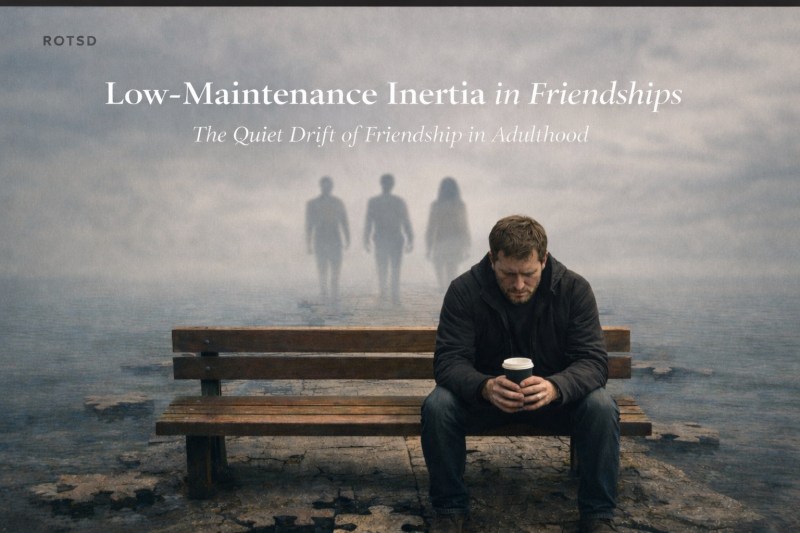
Do you find yourself sending a message and watching it sit unanswered for weeks? Struggling to remember the last time you met a friend one-to-one? Noticing that when you do meet up, it’s usually as couples rather than simply as friends?
I have found this to be increasingly common in adult life — friendships simply ticking over day to day, minimal effort, slow momentum, until suddenly they drift into a quiet, low-maintenance state. There is no falling out, no hostility, just a gradual slowing of responsiveness, friendships quietly deprioritised rather than consciously discarded, that I can only describe as a low-maintenance drift of the friendship.
The strange part about this drift is how invisible it is while it happens. Friendships rarely collapse in dramatic ways; more often, they simply lose momentum, month by month, until the distance only becomes visible when something important happens and you suddenly want to reach for the connection that once felt effortless, but now feels like an inertia.
So why does this happen? My theory — based purely on observation — is that it sits within our increasingly busy culture. We are always striving for more: a good job, financial stability, a home, the ability to support a family. Romantic relationships often become the default social unit, while parenthood and careers consume most of our available bandwidth. At the same time, digital communication creates the illusion of connection without requiring the effort that real connection demands.
I have been ruminating on this idea of low-maintenance inertia for months now — perhaps even a couple of years. One thing that stands out to me is that men seem more likely to fall into this pattern than women. I often notice “girls’ nights” or women intentionally maintaining their friendships, whereas many men tend to socialise through their partner’s networks rather than their own.
This raises an interesting question: do men prioritise their immediate sphere over their wider sphere? In other words, does the focus on home, partner, and children gradually replace the maintenance of friendships? If so, could this partly explain why so many men experience loneliness or struggle to speak openly when they face emotional difficulty? Perhaps when the moment comes to have those deeper conversations, they realise the friendships that once held that space have quietly drifted into inertia.
The difficulty often begins when you finally notice the inertia. That awareness usually arrives at the same time as a sudden craving for the friendships that once existed — the deep conversations, the shared perspective, the sense of cognitive companionship that used to come naturally.
Instead, you begin to encounter slow responses or silence. Frustration creeps in. Patience and energy begin to erode in subtle ways. You seek perspective but find quiet. The mind starts to ruminate and reflect, and a quiet loneliness can follow.
The strange part is that nothing has really changed. Your friends are behaving much the same as they have for years — and, if you’re honest, perhaps you have been too. The difference is that now you are the one who has begun to notice the inertia. You are the one beginning to crave the change. They may not even realise it yet.
For a long time, I was quite content letting my friendships tick along quietly — chatting when we had time, meeting up occasionally when schedules allowed. But a recent life shift has made me notice the distance more clearly. Conversations that once happened daily or weekly have slowly become monthly, or even less frequent.
My partner and I are expecting our first child, and I found myself in an unexpected position: worrying that telling some of my closest friends might result in the message sitting unread for weeks. Not because they do not care, but because this is the rhythm our friendships have quietly fallen into.
I watched my partner discover the news in a very different way. Within minutes, she FaceTimed her friends. They picked up immediately, celebrated with her, and shared the moment together.
Meanwhile, fourteen weeks passed, and I found myself carefully drafting messages — trying to create the right opening that might lead to a conversation, before eventually realising that the simplest option was to send one message and share the news directly. Anything else might take months to unfold through the usual slow exchanges.
To be clear, this isn’t true of all my friendships. One friend visited and found out very early on. But the experience highlighted something unexpected: when friendships have lived in this low-maintenance state for long enough, even sharing the biggest moments in life can begin to feel strangely awkward.
It’s important to note that this isn’t about the end of friendships. Rather, it is about recognising when these relationships have quietly been taken for granted and infrequently nurtured. Life gets in the way of most things. It is rich, chaotic — and that is part of what makes it wonderful.
In many ways, the longing to reconnect with these friendships only highlights how fortunate I am to have these people in my life. I am deeply grateful for them. They have shaped me just as much as I have shaped them. But recognising the inertia is important, because sometimes friendships simply need a little attention before the distance grows too great.
So how do we break the inertia? For me, this is still a work in progress. I certainly don’t have all the answers, and every friendship will likely require a different approach. The first step, however, is simply naming it and recognising that it exists. From there, it might mean being more intentional about organising time together, rather than waiting for convenience.
For me, reflection has also helped. Thinking through the idea, writing it down, and shaping it into this blog post has allowed me to understand my own thoughts more clearly.
Finally, there is also an acceptance that some friendships are seasonal rather than broken. People move through different stages of life, and relationships naturally shift with them.
The aim of this post was simply to put words to something I had been quietly ruminating about for some time. If you have felt this drift too, then perhaps it helps to know you are not alone.
When was the last time you reached out to a friend simply to maintain the friendship rather than because circumstances brought you together?
Sometimes friendships do not fracture — they simply fade into inertia. The real danger of low-maintenance inertia may not be that friendships end, but that we only notice their value at the exact moment we realise how quiet they have become. Perhaps naming that inertia is the first step toward restoring the friendships that once provided that quiet form of cognitive companionship.

